I caught the coach to London at 6.30am. I’m armed with my charcoal pencils and sticks and my small A6 sketchbook. I’m hoping to complete my derive exercise on this trip. I haven’t been to London for years and thankfully I was sat with three nice people who pointed me in the right direction for the tube. This is quite an adventure, and I can’t wait.
I arrived in time as my ticket was for 11.40am. I had to take one or two photos before I entered.
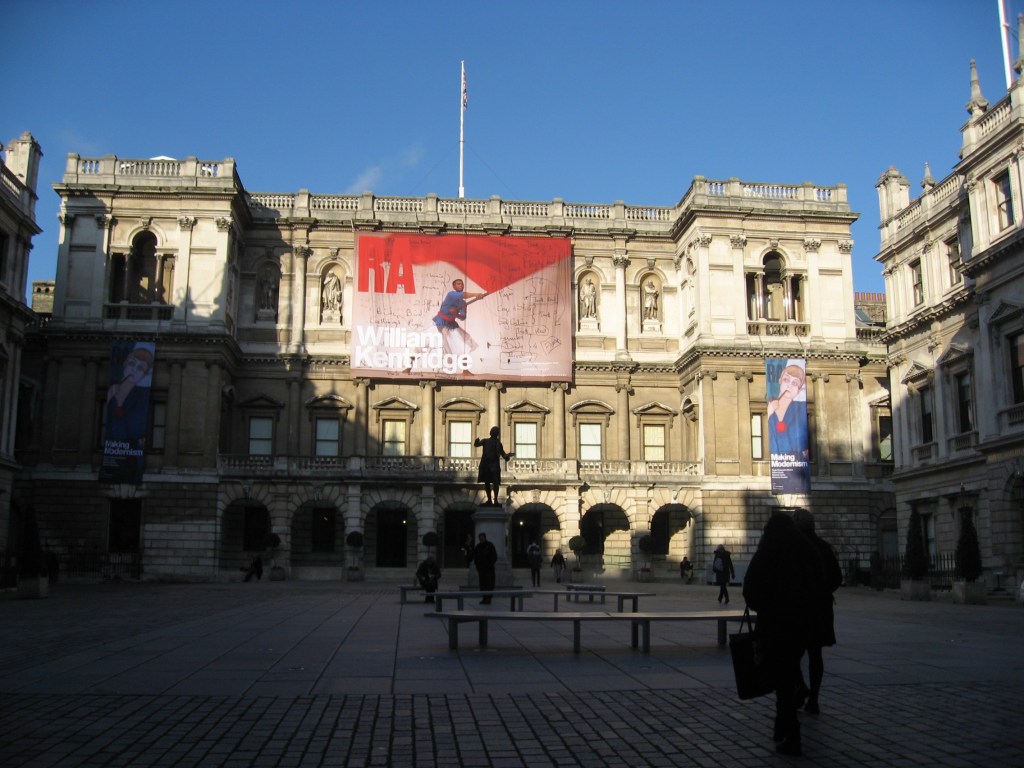
It’s a bit sunny and there’s lots of shadow. I’ve arrived! I’d taken along the OCA document on getting the most out of an exhibition visit. I did loosely work to this but wanted to really find out more about Kentridge. In this regard I also purchased the RA catalogue which was a hard cover book costing £30 but it was well worth it. All the work from the exhibition is detailed inside. From an early age Kentridge seems to have been quite a political animal. Both parents were lawyers and well educated. His father was involved in defending those involved in the Treason Trials between 1956 and 1961. There were 156 people arrested and his father represented Stephen Beko. His mother was also a Co-founder of the South Africa Legal Resources Centre which gives free advice to poor and marginalised people.
The exhibition was a little difficult to follow in terms of when events relating to some of the drawings took place, but I took photos and was able to piece things together better afterwards with the help of the catalogue. The catalogue is interactive with an app to access some of the video work.
This exhibition was around five years in the making from when Kentridge was approached by the RA. In this respect I thought he had made a lot of his drawings at the time the events were taking place, but in actual fact he was recalling from memory and doing a lot of the work retrospectively or they were conceived much later in the eighties and nineties. A lot of the work is also on loan from private owners.
The medium of charcoal and Indian inks was my main focus but you just have to give credit to other great aspects of the man’s work. The animations are just sublime. You can see the different charcoal drawings, each one exquisitely drawn and then the erasure marks as they are rubbed out and redrawn. Every new image is a reformed. Stephen Clingman the author of the catalogue spent a lot of time with The Kentridge family, and he mentions how “the processes of erasure and construction are based on Kentridge’s use of metaphors for everything he does. The new ways of discovering things are through a play of difference, opposition and unexpected analogy.”
Dare I say it, but this theory relates again to the philosopher, Jacques Derrida. He like Kentridge’s work really resonates with me. I could also add that the erasure is about what isn’t there! I was blown away by his work. Most of it was on such a large scale and was very moving. We see images of a dead infant being carried. We see the slow progression of images of people fleeing and migrating. We see brutality of the army as he documents through his drawings about apartheid. There were several large screens with animations and each they lasted just a few minutes.
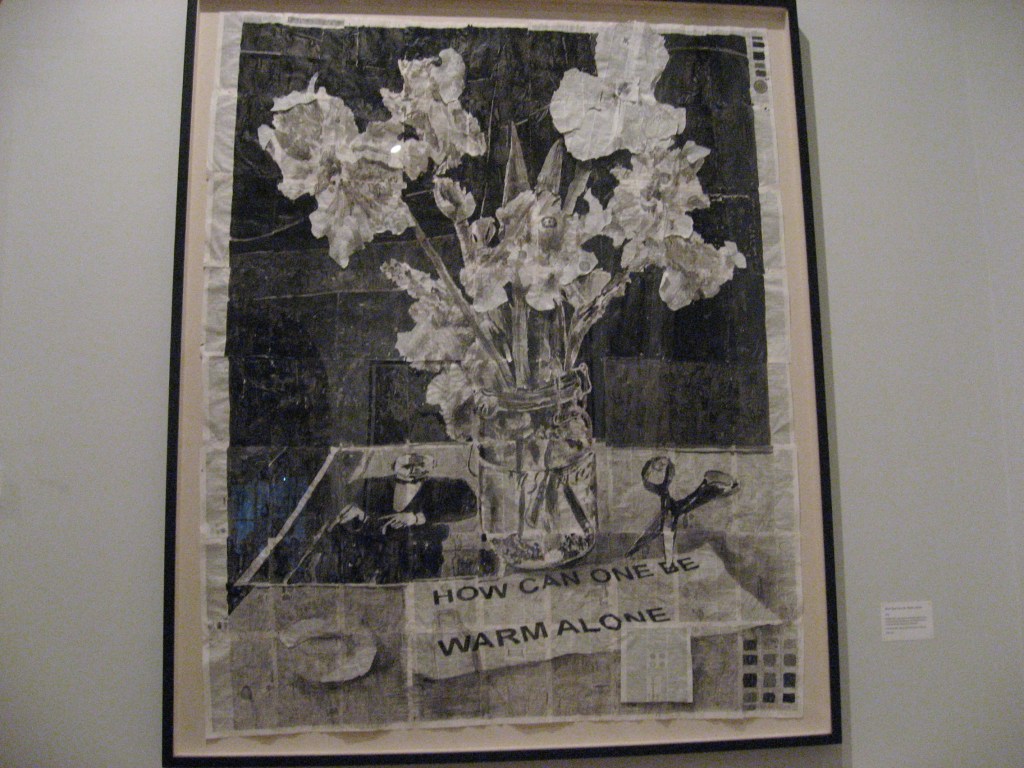
One of the things I noted about a lot of the work is how huge they are. One or two of the collage works such as the flowers as below were not that well finished. This reminded me of my visit to see one or two original works by Hopper. Some of the edges of the paintings were not that sharp despite them being brilliant. I did love the flower collages and I was quite inspired by these too. One is below. As youcan see the edges are a bit curly on the outer paper. He constructs these with layer upon layer of the petal shapes.

I include this cut out collage as it’s relevant to our mapping exercise. This was a hand woven tapestry.
There are too many images to include but I intend to build on this page on Kentridge. It was an absolute privilege to see this work and I need to do him justice. This is only the beginning.
 Drawing 2 Interpreting the environment