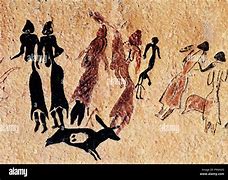
Having read the introduction and the mention of Levantine Art I wanted to find out a little more about ancient and historic drawings. I googled Levantine Art and found two main websites. Whilst I’d seen drawings from inside caves I hadn’t fully appreciated them before. I downloaded a couple of images from what is known as the Levantine region. see map below.
The first website was Levantine Art of the people. I was able to see specific works and watch an animated video of the evolvement of the art.
https://artprimer.mac.cat/en/3-levantine-art-of-the-people/
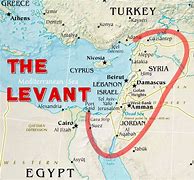
The images are below and are under bing images.
The second website was the Bradford Foundation which encompasses a more global approach and researches historical finds including cave art from across the world.
I downloaded this page of the website that included the archaeologist with some of the drawings.
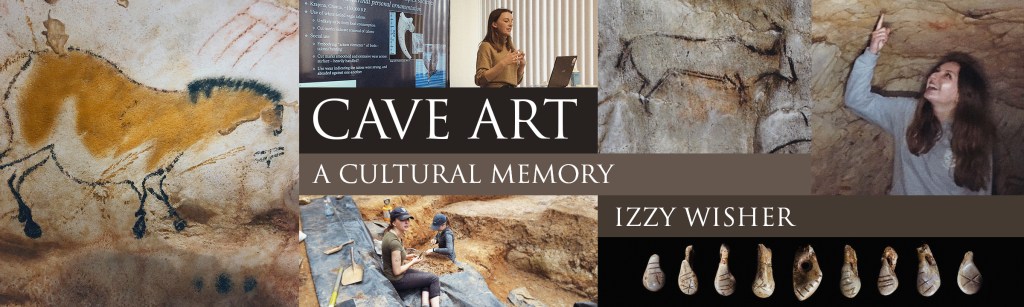
It was great to have a glimpse of some of these fascinating drawings and to realise how fortunate we are that the narratives of these ancient peoples lives on. Every drawing tells such a valuable story and they would have used such primitive but beautiful tools. The drawing may sometimes appear childlike but they have all the elements that visualise and interpret as we do today in our own art. The images are a real source of inspiration so I may well come back to these sites.
Reading point Creating a Narrative Pages 113-127.
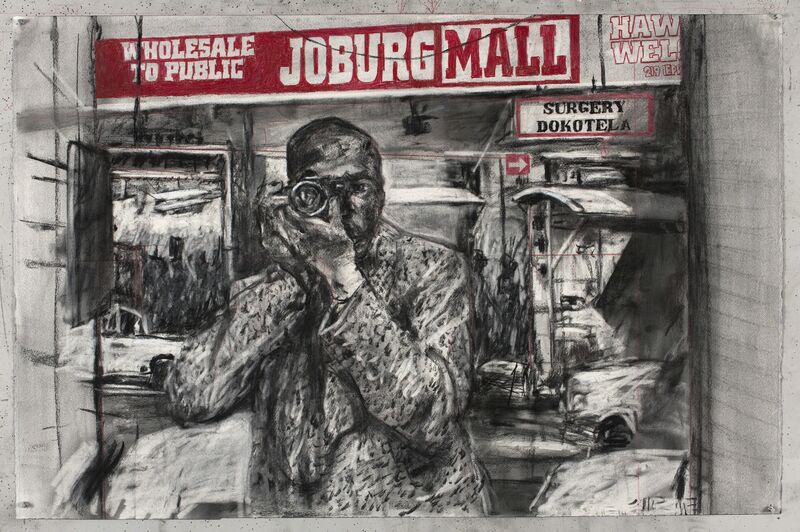
I found this text on Re[portage Illustration and Journalism really inspiring. Such a wealth of visual information can be conveyed in so many individual and diverse ways. From one facial gesture through one frame to several frame storytelling and the possibilities and potential is endless, timeless and open to the imagination. The comments by Louis Netter were interesting and very thought provoking. He explained that he was inspired by the work of William Kentridge. I had heard of Kentridge as I worked on my critical review which covered research on racism. Kentridge is a black South African artist and his drawings that very sensitively depict the struggles in South Africa. I researched and found one or two of his images below.
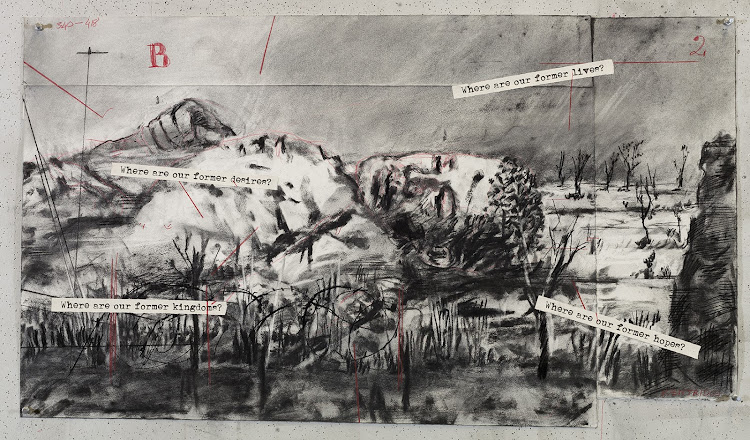
The image above is titled Kaboom The Head and the Load Undated The Goodman Gallery.
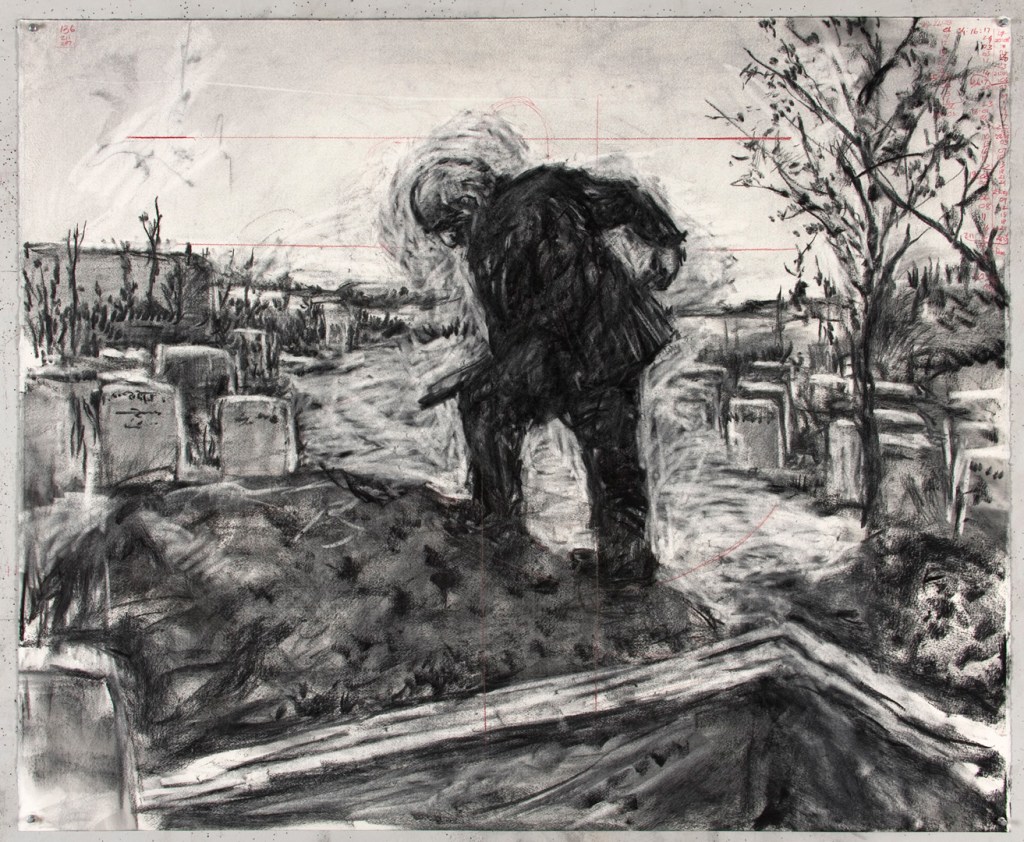
The image below is one of a series of drawings titled Other Faces. It is in charcoal and coloured pencil on paper. (100.1 x 120.97cm) It is dated 2011
https://www.artsy.net/artwork/william-kentridge-other-faces-1
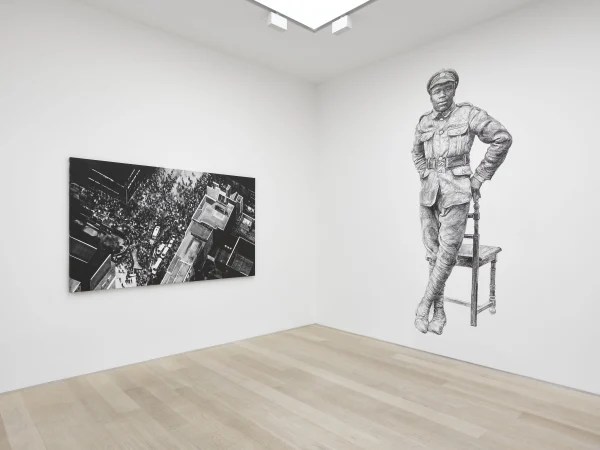
Louis Netter also made an important point about working with art directors or clients and his point was about being true to yourself. I would imagine that if you are commissioned to undertake a work or project the commissioner is going to have some idea about how they see things in their minds eye. There might need to be some compromises but I do think there is a limit to how much you might want to adapt your work or ideas to suit others. If your work becomes like its alien to you then I think you shouldn’t take on something you are not happy with. Chloe Regan also mentioned some useful points about her processes and materials. I liked how she doesn’t carry a rubber/eraser as she doesn’t believe in a bad drawing. Her range of materials included using a 98 pencil, pencil crayons, pro-markers, posca pens and graphic fine liners. Composition was very important to her drawing and forms a large part of her visual language. I do think composition is crucial and sometimes a more unusual composition can work well and engage the viewer. A viewfinder can be helpful and I usually adopt a ready made mount card. In further regard to materials, I think its important to try and test out what suits your style and situation and also the subject. For example more dramatic, sorrowful scene’s may best be suited to dark charcoal colours. I’m trying in this module to really improve on my drawing skills. I like to draw in paint straight onto a canvas but out in the field I might use a range of graphite, pencils and mainly watercolour brush pens. During this course I hope to work more with charcoal. I was really inspired not just by Kentridge but Barbara Walker’s work. Her very large works in conte crayon of black war personnel that were never given any recognition, are exquisitely well accomplished. I draw on one example below as I covered her in POP2 and for my critical review.
This image is from a selection of gallery shots for her exhibition titled Protest and Remembrance.
I also considered the suggested exercise in the article and the approaches to drawing. My approach is similar in that I usually draw outlines of my subject and create the shapes. I then build up the tonal areas. I think overall the article provides some good sound advice.
Further research.
I followed up the suggestion of considering the work on storytelling and the exhibition at the Guggenheim. It’s title is Storylines: Contemporary Art at the Guggenheim Museum.
As I clicked on the page you are able to see such a numerous eclectic mix of works by various artists and the background page includes the word storylines. As you click on one you can find out more about the artist and the work.
I also found on bing a link explaining the exhibition and narrated by curator Nancy Spector. The exhibition includes work by various artists commissioned by the Guggenheim, New York. It’s about narrative in art in it’s many forms. From painting, video sculpture, photography and installations. The artists selected are deemed to be pioneers in their field, either through some political, social or everyday work they create. The exhibition was inspired by the work of Felix Gonzales-Torez and his gold curtain. In our information for part 1 we are introduced to his work called Blood lines. The artist died from Aids in 1995. The narrator explained how The gold curtain was a kind of catalyst for the exhibition as Gonzalez-Torres was considered as an artist who used the power of abstract form to convey such important meanings both politically, socially, health issues and cultural issues. The exhibition also invited poets and writers to collaborate and share their ideas on the work hence the texts we see as we look at the work.
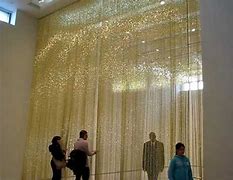
There is a website devoted to the artists memory
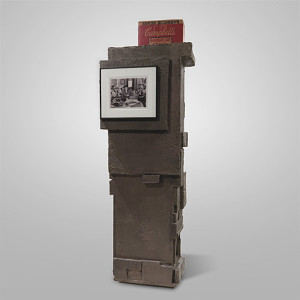
I copied fully for the first work the description and the biography.
Rachel Harrison deploys a wide range of influences in her work, combining art-historical and pop-cultural citations with explorations of material, color, and form. Her hybrid sculptures enact a range of dialogues—between handcrafted and commercially produced objects, aesthetic and consumer goods, among others—and engage broader social and political histories of exchange. All in the Family (2012), an upright, top-heavy construction painted deep aubergine, acts as a display mechanism for a bright orange Hoover Vacuum Cleaner. This classic domestic appliance poses as a sculptural artifact or a figure from a retro sitcom, while alluding to Jeff Koons’s seminal 1980s series of encased vacuum cleaners. Blazing Saddles (2003), which takes its name from Mel Brooks’s 1974 satirical Western, features a framed production still from The Fuller Brush Girl (1950) showing Lucille Ball being held in a stickup by two children dressed in cowboy costumes. Above this image sits an empty case of Campbell’s Barbecue Beans, calling to mind Andy Warhol’s soup cans and silkscreened boxes of the early 1960s, as if to say that Pop art itself may continually be repackaged and resold, much like other exports of mid-century Americana.
What is important to me in looking at the work is that unless you know and are familiar with say the film, Andy Warhol and the other elements you might not appreciate the work or understand it. I appreciated the nostalgic journey. The message about repackaging resonates as all artists are usually replicating others work.
I also wanted to know how it was made so downloaded the details.
Wood, polystyrene, cement, acrylic paint, cardboard Campbell’s Barbecue Beans box, and framed inkjet print, 72 x 22 x 20 inches (182.9 x 55.9 x 50.8 cm). Solomon R. Guggenheim Museum, New York, Purchased with funds contributed by the International Director’s Council and Executive Committee members: Ruth Baum, Edythe Broad, Elaine Terner Cooper, Dimitris Daskalopoulos, Harry David, Gail May Engelberg, Shirley Fiterman, Nicki Harris, Dakis Joannou, Linda Macklowe, Peter Norton, Tonino Perna, Elizabeth Richebourg Rea, Mortimer D. A. Sackler, Simonetta Seragnoli, David Teiger, and Elliot K. Wolk 2003.66 © Rachel Harrison
From the information provided all of the artists have been sponsored and supported financially to undertake the work.
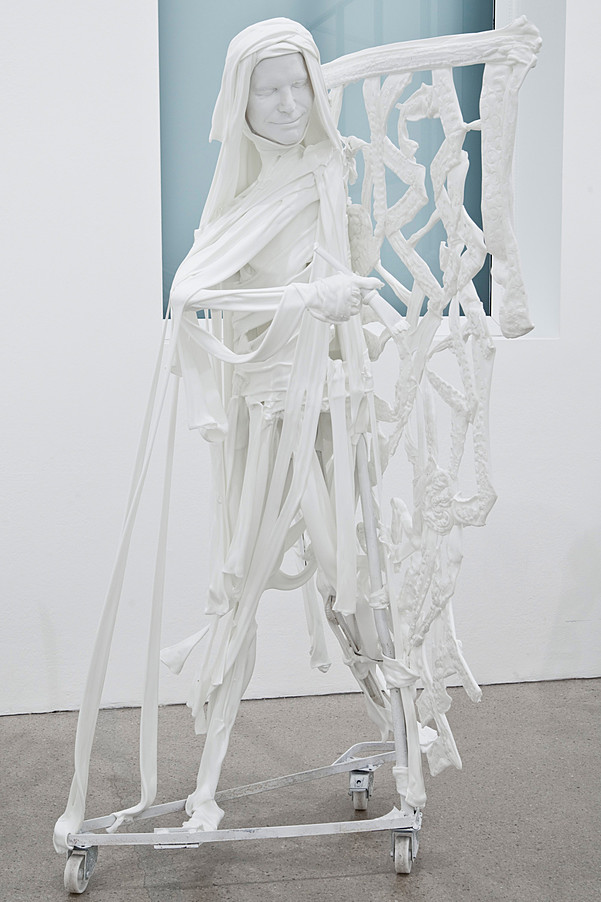
I couldn’t resist this as my next choice. The description is below.
Pigmented plastic, plaster, paint, paintbrush, and steel armature with wheels, 75 x 41 x 51 1/2 inches (190.5 x 104.1 x 130.8 cm). Solomon R. Guggenheim Museum, New York, Commissioned by Deutsche Bank AG in consultation with the Solomon R. Guggenheim Foundation for the Deutsche Guggenheim, Berlin 2012.185 © Paweł Althamer. Installation view: Paweł Althamer: Almech, Deutsche Guggenheim, Berlin, October 28, 2011–January 16, 2012. Photo: Mathias Schormann
Althamer’s father was quite and entrepreneur as Poland began to get on it’s feet after the war and he owned a plastics factory. Pawel uses the general public to cast the faces and its based on visitors to the Guggenheim museum. He likes to involve the public in his work and used some of the materials from his fathers factory. Using the metal structure gives me a sense of a Zimmer frame. The face almost smiles and I can imagine the man enjoying the involvement in the work. The interwoven fine sections are intriguing. I like the idea of involving the public.
Another artist was Gabriel Orozoko and his work was titled Astro turf constellations. Images of his work are below.
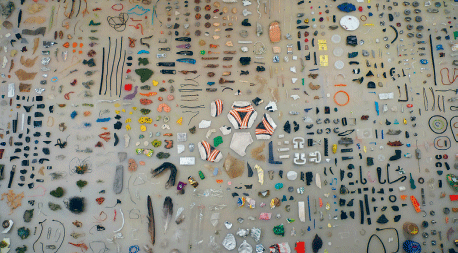
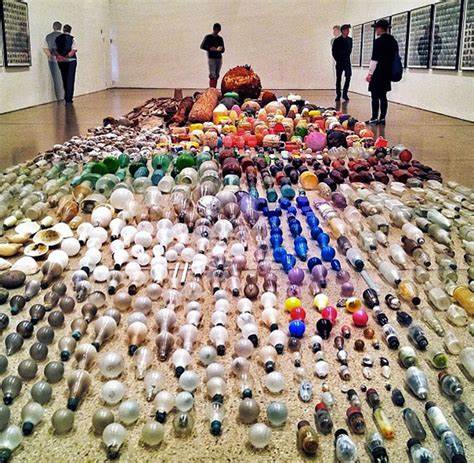
His work above is a collection of artefacts found over a period of time on an astro turf playing pitch. The artist explained in a video how used to go and play with a boomerang on the pitch. He was amazed at how many things could be found on the pitch. Some of the items included chewing gum and sweet wrappings. The collection of items was huge and formed an array of installation work.
Taryn Simons work involved portraits of everyday people from across the globe.
The State Council Information Office for China when asked to select a bloodline for the project they chose a very middle class family. Work redacted when shown to China was a South Korean who was abducted. The artist then adjusted this as an abstract of three black blank panels.
I looked at a wide range of the work and it was interesting to see the different takes on narrative and storytelling. The message was clear that all artwork has a narrative of some kind. It begins with the idea and can unfold or be created in so many different ways. I loved looking at such a diverse range of work.
Research Task Monoscenic narrative
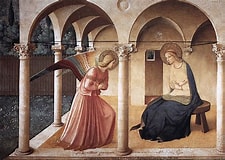
I considered the task of comparing the work of Peter Doig, Paula Rego and Jorg Immendorf in our workbook, with the work of Fra Angelico and Sandro Botticello. Examples of the latter two are below.
Below is Fra Angelico’s The Annunciation.
Sandro Botticello’s work includes the Birth of Venus
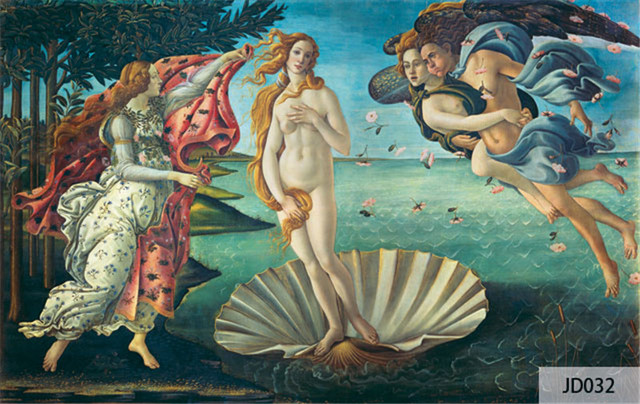
I think that all of the five artists create both mood and drama in their work. The main thing that separates them and the centuries is mainly style and techniques. Whilst the early paintings of the 1400’s clearly have a classical style common of the period they have great drama, some surrealism and storytelling. The Annunciation is an early Renaissance Fresco painted in San Marco Convent in Florence. All of the artists provide us with a sense of mystery and intrigue as our eyes scan the images. The motivation for an air of mystery can be a little unique sometimes to the artist. They are inviting us to interpret sometimes for ourselves what we see or imagine to be going on. If I look at Doig’s painting we are not sure whether the boy or figure is standing on ice. The boy seems to be standing in a circular puddle but the long vertical shapes in the water reflect the trees as if glass like. Sometimes the title helps us to interpret the work and this one is called Blotter. We then question soaking up water as a blotter does, or is it about a blot on the landscape as the boy looks down. There have been many interpretations and analysis of old masters works and we have learned a lot from their styles and techniques. What separates the more modern artists from the classical artists are the techniques and style. The classical artists would be applying layer upon layer of paint to create their work and the style would be of the period. In contrast Rego for instance uses more immediate pastel and paint. Modern day materials make creating paintings more versatile and immediate.
Research task Narrative
In preparation for thinking about how we can apply narrative to drawing from a
time and place take a look at chapter 2, Drawing Archaeology by Dr Helen
Wickstead, in Drawing – The Purpose by Leo Duff and Phil Sawdon (2008),
specifically the section Drawings about Drawings–Narrative, pages 23-26.
This text is from your essential reading list and is available here as a free
download from the UCA library:
https://ucreative.idm.oclc.org/login?url=http://lib.myilibrary.com?id=203510
Research and reflect on this work in your learning log. Look also at Doug Burton’s
piece in the We are OCA blog: https://weareoca.com/subject/fine-art/here/
This whole book is full of interesting details about drawing its meanings and how it is used. This part of the text is about how archaeologists make drawings upon drawings to make orderly sense of how to curate their work. The exquisite drawings in the text include drawings of the historical graves. All of the drawings are archived so that those who come after can access them. It’s really great to be exposed and to learn more and more about drawing from primitive styles, repetition and refinement. I’m beginning to be far more confident in my drawing but I do still feel I need to go straight to a canvas to do my best work. Through the sketches done I can however see more merit in really going for it with different materials.
I also looked at Doug Burton’s comments about the book Here by Richard Maguire. I think the artist has captured a fascinating idea and concept through depicting everyday life as it unfolds through the corner of a room.
Charlotte Salomon
Research Task: Charlotte Salomon
Reflect further on the artist and her overtly personal collection of work by
researching books and online.
In your learning log write down your thoughts:
● Do you think the strength of her work lies purely in its remarkable
narrative or, without knowing the story could we appreciate it solely from
the quality of drawing or its expressive nature?
● Can you see the influence of her artistic contemporaries in the work?
● If so who and in what aspect of the work do the influences lie?
What a totally tragic family. I was so really touched by the information about this artist and her work. I mainly read about her life on the Art story website.
https://www.theartstory.org/artist/salomon-charlotte/
The information about her provided a good chronology of her life and events. Whilst she died in 1942 in the gas chamber of Auschwitz she was five months pregnant. She was only twenty six and not only was her own life shortened in this way but she was from a family where suicide featured largely and seemed an hereditary trait. Both parents and grandparents commited suicide. While my task isn’t to necessarily go through her full life story I believe she really captured narrative in a fairly unique and expressive manner. I include some of her images from her book below.
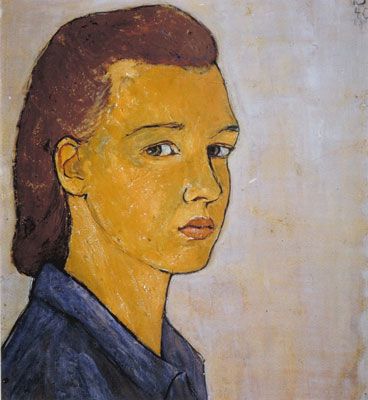
The self portrait is not happy but very watchful and she looks lost and afraid. It’s interesting that she uses black outlines on the face and shirt. Van Gogh was the first artist to use the outlines and I believe he adopted this from oriental art.
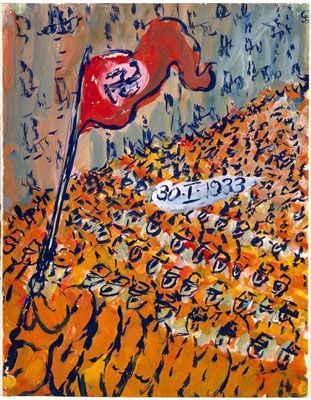
The way she has drawn the soldiers from an aerial perspective helps us to visualise the huge number of the soldiers all with the same undescriptive faces. This is very cleverly done and really effective
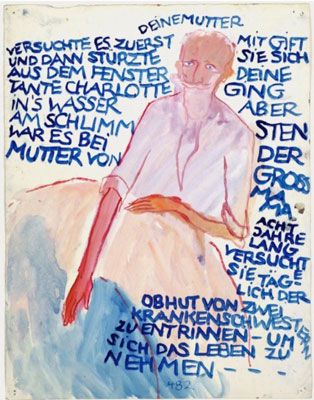
I would love to know what the words are in one sense but in another I know they are very upsetting.
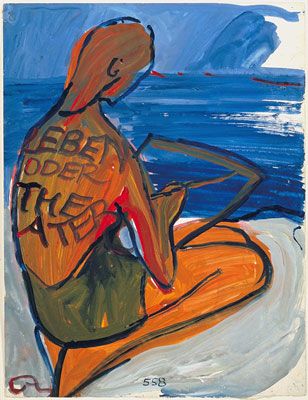
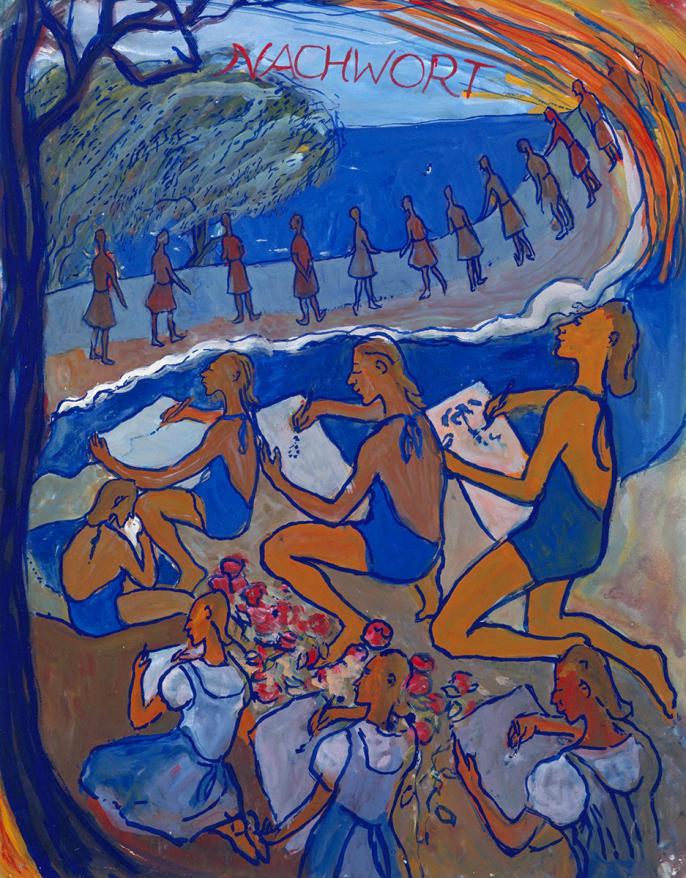
The artist did have formal training as an artist at the State Art Academy in Berlin. It was however lucky she got in as a Jew as they only accepted 1.5% of Jews into the school at that time. Her talent was recognised by a private instructor.
Salomon’s work has a very distinct style and I can see traces of artists that have influenced her. In the latter two paintings I can see resemblances to the work of Matisse. I visualise his cut outs and the use of the blue colours. In contrast however to Matisse the figures are far more anatomically and technically well drawn. In this regard you are well able to appreciate her work for the quality it exudes and the explicit narratives. The work is very graphic and the narratives are strong often leaving little to the unimaginable. In the painting where she is sat with a frame on her lap, I am reminded of the work of Magritte. The empty frame only lets us visualise what’s beyond, the sea and the girls leg. I googled the meaning of Nachwort in German and it means epilogue so this more joyous painting was perhaps the last in her book. Her work and drawing must have provided not just a form of therapy but also some form of comfort in letting her emotions and feeling out and to help make sense of things. Drawing lots of others drawing was her way of letting us know that drawing is good and her way of maybe encouraging and providing hope for others.
 Drawing 2 Interpreting the environment