Turner
Researching this great artist is fabulous. I’ve always loved Turners work as it’s not just about the motion, energy and movement, but it’s the way he creates such fabulous light. The National Gallery hold several important works so I was able to download one or two famous images from their website.
https://www.nationalgallery.org.uk/paintings/joseph-mallord-william

The image above really helps us recognise the dangers and perils of the sea. The dark clouds engulfing the boats are reflected in the colour of the sea and there’s lots of foam. The waves have movement as the artist has created craters or huge crescent shapes in the water. What is interesting to note is how in the distance on the right he paints a dark band of almost black but then above this he lets us still see a distant band of foam. This helps draw the eye to the distance.
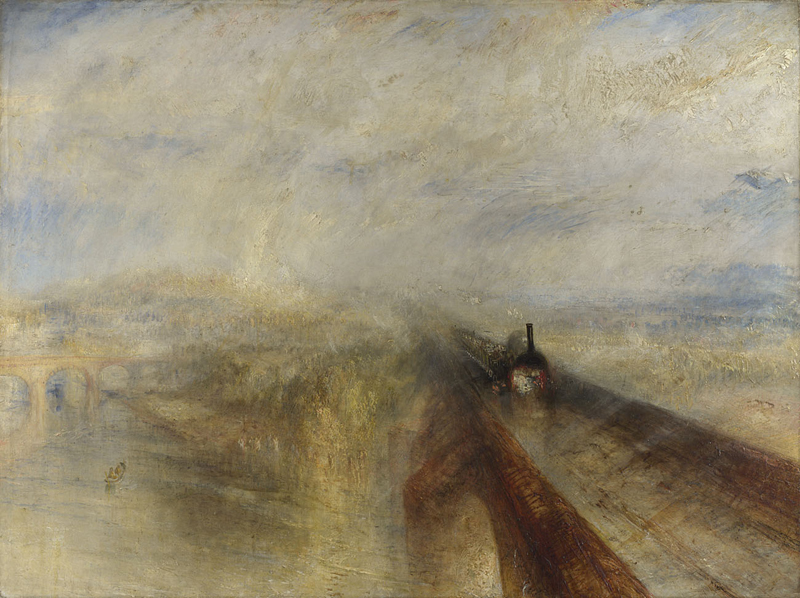
I couldn’t help include the image above. The water is below and we can see the small boat. Again we have stormy skies. However Turner ceates the movement of the train through the depiction of the rainclouds and by the way he’s graduated the train into the cloud. It’s just brilliant.

I can’t help but test out a seascape in charcoal. My first attempt isn’t bad but I shall do more. What I love is practicing a new technique learned from one of Kentridge’s landscapes. He draws a waterscape and seems to pull down the charcoal with perhaps an eraser. I try this in this first water image at the bottom of the page and I can see how I can use the technique. Thank you again Kentridge!

Kentridge is speaking to me again. The possibilities are endless with this medium. He’s right. I shall do more seascapes to reflect motion in another section.
Calder’s Circus
I managed to find the video of the circus and I also watched a panel discussion about him from 1998. It was Calder who gave us through his creations the term mobile. This was apparently Marcel Duchamp’s suggestion for what Calder should call the sculpted mobiles. They were good friends. Watching the circus was fascinating as we see Calder working his circus performers. These were a range of different animals and figures that he had made but through use of wire and twine he was able to mobilise the figures through pulling the wires. They were able to perform as circus animals would.
https://www.bing.com/videos/search?q=Calder+Art&&view
The above link is to the panel interview. The circus video is below.
Calder’s work is fascinating and he must have had to use a lot of mathematics and/or geometry in producing the work. For example the mobiles were self propelled in terms of some of the movement. This must take some fine balancing. Some work was motorised. Kinetic art is all about the movement in space and for the viewer to experience this. I also watched a video of Calder’s work at Tate Modern. It was quite moving to see the mobiles gently moving as if in the breeze. What I particularly liked was the shadows they produced that also kept changing on the walls of the studio. The mobiles were made again through the use of wire.
I researched further as we were to find out more about his drawing practice.
I came across more information which did explain and answer my questions about the precision in his work. On the National Gallery of Art website below. There were projects and exercises for students to undertake on Calder such as making a mobile. The information stated that Calder had a degree in engineering before he became an artist. He also drew the circus animals from visits to a zoo. Other information from the site suggested that the mobiles were a fine balancing act achieved through a lot of trial and error. The site below was for teachers and I did try to access a DVD on printing. I entered my details as a student but will see if I get any response.
https://www.nga.gov/learn/teachers/lessons-activities/counting-art/calder.html
Research task Programmed drawings
● Search for Verostkos’ “The Magic Hand of Chance”, presented by the
Minneapolis College of Art and Design in 2014, and for interviews with
Verostko.
● Compare Verostkos’ drawing methods with Nick Laessing who uses
natural and mechanical forces to power his mechanical devices to produce
drawings.
● Search for his spatial harmonics installation.
It was difficult to find the necessary information but I think I have found enough information to understand Verostkos’ art. My first source of information was from the Digital Art Museum website as below.
https://dam.org/archive/essays/verostko01.htm#magic
The title of the article is called Epigenetic Painting, Software as Genotype, a New Dimension in Art.
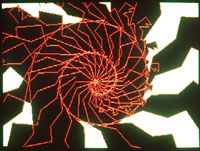
Verostko presented an article at a syposium, the first international one of it’s kind on electronic art in 1988. The article has been updated and included revision to 2002. The drawing below that I include is from the article and is only 5ins by 3ins. It is an epigenetic pen drawing.
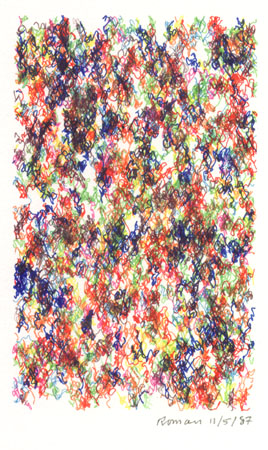
The article written by Verostko takes us through how he has been able to generate digital art through use of various computor software programmes. The first one he used was one he developed himself called Hudos. The image above is from that programme. The writer explains in the article, the process of his discoveries and the essential features in creating art and how decisions about making it are arrived at. He clearly raises the ethical questions and promotes the use of generating such art suggesting that the work around it provides important questions for the future of art.
While I am not very conversant with computer programming and chips and am probably a purist in regard to hand painting the more I read the more I can see where this kind of art becomes important and relevant. Verostko provides various examples of the similarities that can be generated through use of this art in comparison to the traditional hand painted. Firstly however, he makes reference to how the software provides artistic improvisation and innovation variation without the artist being present. He argues that Although each work may be “one of a kind” it does belong to a family. We must ask whether, to what extent, and how the artist’s hand is present in the work or in a family of works. What can we say of the apparent feeling in the brush strokes?
The artist then goes on to consider the software Hudos as having a gene present and refers to it as a genotype and further that this genotype is the code for making the work. He continues to say that the code can also make a family of works and that each work is unique, one of a kind yet familial. He then refers to how the software can hybridize and cross over the different artists work.
Further considerations arise around authorship and the role of the person generating the art.
The article is a little more informative on the processes involved in generating the art. For example in order for each artistic procedure to be consolidated into the software and coded the procedures are broken down. He give an example of the line in drawing in all its dimensions including colour, flow angles and length, needing to examined and determined into code. This in my view must be quite a laborious task and this is only one element of artistic practice. As I read further even the emotional aspects of generating the art are plausible.
The Magic Hand Of Chance refers to sequences of mimed automatism of lines shapes, colors, words and syllables and sounds. These are some of the images generated from this series of work. The second image generates the letters at random but we can see the chance word in the fourth row. It is done in a six by six sequence of the letters.


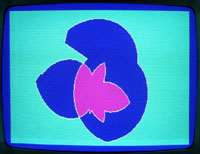
Whilst visually the work can appeal and it has a place in artistic genre, I think I’m a traditionalist at heart.
Nick Laessing
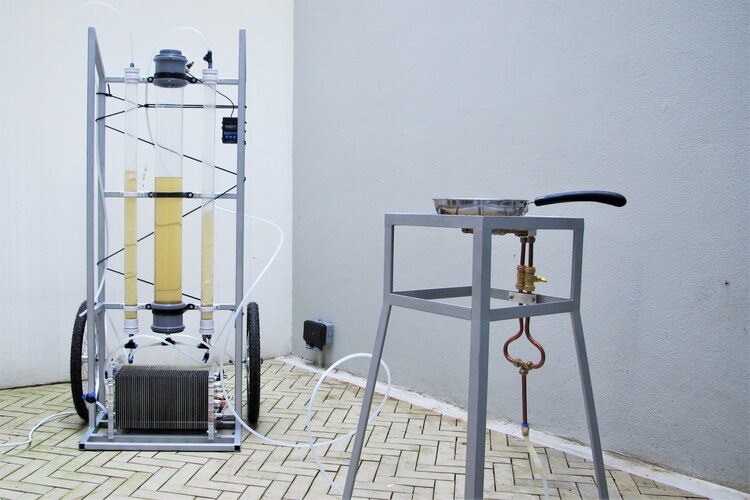
This work is titled Hydrogen kitchen

The above is titled Plant orbiter

The above image is titled Water gas car
As I stepped into this artists world it was very clear that he is creating examples of environmental, planet saving work! His educational background is not just in art. His website states that ‘He is currently a PhD researcher at The Slade School of Art and The Electrochemical Innovation Laboratory, University College London, researching evolving methodologies for artistic practice within discourses of the Anthropocene and eco-crisis.’
Anthropocene is the point at which human existence and activity has had an impact on the climate and the environment. Some findings of the effect can apparently date back to the early 1800’s.
On his website there’s a video that shows the artist cooking an egg in a frying pan which is cooked by the energy from the hydrogen kitchen above. It is very clear that even art schools are really diversifying and promoting innovations around ecology. I found Laessings spatial harmonics installation at the gowan contemporary gallery below.

http://www.gowencontemporary.com/time-braden/nick-laessing/
On the UCL website I also found the drawing below that helped advertise a talk Laessing was giving on pigments and ecology. This would have been very interesting to me as I do want to try to be more eco-friendly in the materials I use.
https://www.ucl.ac.uk/slade/news/2020/07/pigment-farm-talk-nick-laessing-ecologies-of-practice

Comparing Laessing with Verostkos is very difficult. Both are pioneers in their field. One is more computor based while the other I guess is more scientifically based as he researches more into ecology. His finding are then transformed into examples of how through use of different energy forms or refining or redefining these we are more aware of the issues. This in my view is a better use of art than that of Verostko. His work in some ways eliminates the true artist as a person.
Kara Walker Research task
Search online to see extracts from one of her films Rise up Ye Mighty Race
(2013) and for interviews to find out how she moved from painting to her
current practice. MAC (Metropolitan Arts Centre) Belfast have uploaded an
interview to accompany her 2014 exhibition. They introduce it with, “We at
the MAC are Exceedingly Proud to Present an Exhibition of Capable Artworks by
the Notable Hand of the Celebrated American, Kara Elizabeth Walker, Negress.”
A witty reference to the historical period she explores in her artworks.
● Comment on the way she uses different techniques to speak about the
politics of race. You may find it helpful to look at contemporaneous imagery relating to the historical themes she explores.
I researched Kara Walker a little on POP2, considering her as a pioneering activist artist, and one focussing on colonialism. She is a black American artist and her work is of international acclaim. She is multi talented and her work includes sculpture, cut-out silhouettes’, animation, puppetry and video. These images from the Tate below show the scale of the work and these were from 2009. The themes in her work also explore violence, sexism, gender, sexuality.
https://www.tate.org.uk/art/artists/kara-walker-2674
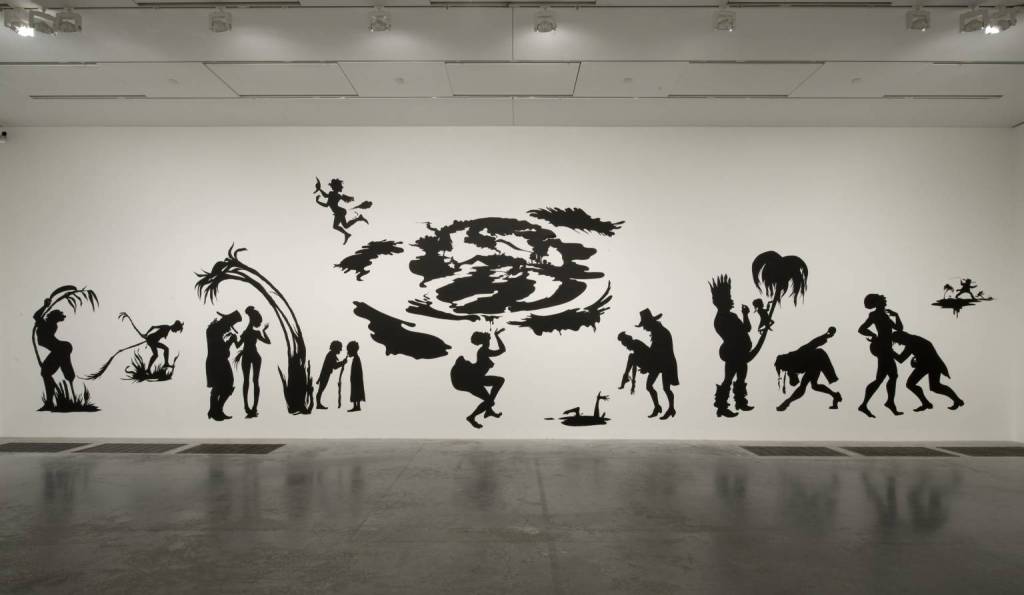
This one also shows the scale as viewed in the Tate.
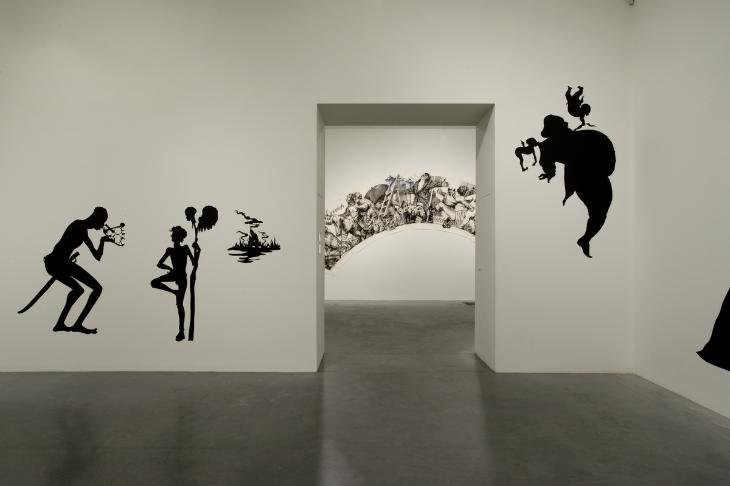

From these early exhibitions we can see that she was producing the silhouettes.
I managed to find a written interview about the Rise Up Ye Mighty Race exhibition on the Artforum website. https://www.artforum.com/interviews/kara-walker-discusses-rise-up-ye-mighty-race-39955
The Rise Up Ye Mighty Race was based on two white supremacist texts from the twentieth century. The title of the exhibition is taken from a book written by Barak O’Bama called Dreams of my father. This was published in 1995 and was about his memoirs. The interview makes reference to how Walker’s debut of her sihouettes took place in 1994 at the Drawing Center. Although the text doesn’t state which Drawing Center I assume it would be the one in Manhatten, New York.
I also watched the video about the Rise Up Ye Mighty Race by the Humanities Festival, Chicago. This was quite interesting as the was only a few months after graduating from art school that she held the Drawing Center exhibition. The artist explained that the shift to silhouettes was for a variety of reasons. She was struggling with the painting and was always trying to snuggle up to what she termed as white patriarchal forms.
I also researched on the art story website around the shift from painting to the silhouettes. The information there suggested that the silhouettes act as a metaphor for the stereotype and in Walkers words ‘they say a lot with very little information’. There are many different layers of meaning in the work and Walker also allows the silhouettes to play tricks with the viewer. Some images may have legs that overlap and you are not sure to whom the legs belong. Sometimes the ambiguities force us to question what we see. She was beginning to critique the institution of western painting and was wanting to move outside the constraints of fine art.
 Drawing 2 Interpreting the environment