An exploration of the skills and techniques employed in charcoal, using comparisons of my work, with that of the South African Artist William Kentridge, and to analyse why and how this medium works for me as a drawing tool in a manner that improves and enhances my drawing skills, resulting in my work having more purpose and meaning.
Introduction
It is important that through my drawing, my work conveys information about important social or political issues, whether local or national events. Social injustice, fairness and equality issues are part of my moral framework and these values will sometimes be reflected in my work. The essence of my work is about the narrative around humanity and what happens to people. For example, the diverse range of work currently includes portraying in a charcoal portrait the struggles and anxieties of one person with mental health issues. In contrast my other work includes depicting in charcoal various landscape scenes of allotments. These latter scenes reflect the personalities of the allotment holders, their commitment and dedication to toiling the land, and their mindfulness of ecology issues. Although very contrasting subjects, both are about the people and their narrative. In this regard it is about their wellbeing, care of themselves and the environment.
Similarly, Kentridge uses his drawings and other works to illustrate political and cultural issues. His work is also about people.
There are two mediums that seem to work better for me but I need to explore further, why they work. From the moment I pick up the stick of charcoal or a biro I feel more confident as I apply each stroke with these tools. In this review I will try to identify why.
I will explore three key aspects of my drawing practice and compare these with South African Artist, William Kentridge. His artistic repertoire includes etchings, tapestry, collage, theatre, puppetry, film, dance, and sculpture, in which he often works in collaboration with others. I shall however in this review focus on his charcoal drawings. The key aspects and my comparisons will be detailed in Appendix 1 Section A
Through researching his work and attending his recent retrospective exhibition at the Royal Academy in London, his work, and his voice has spoken to me, and inspired me, like no other artist, hence my choice.
I will provide both illustrations of drawings and refer to video clips and translations where necessary in Appendix 1. Section A
I will also consider what Kentridge says about his work and some of the important messages therein. To further support and illustrate some of these important points I also include consideration of the work by Tina M Campt. Appendix 1 Section B
My conclusion will include details of my findings and how the use of the medium and researching Kentridge has impacted on my drawing practice, how I better understand it, and how it has also helped consolidate ideas for future work.
My drawing practice and progression.
I am always mindful of the negative space and how this helps for better accuracy. Observing well is key and crucial to the transfer of the image onto the canvas or page. If drawing figures or portraits some of the same skills apply. For example, the face will have strong contours and a plane of dark and light shapes. It is important to recognise these shapes and where the light falls on the face.
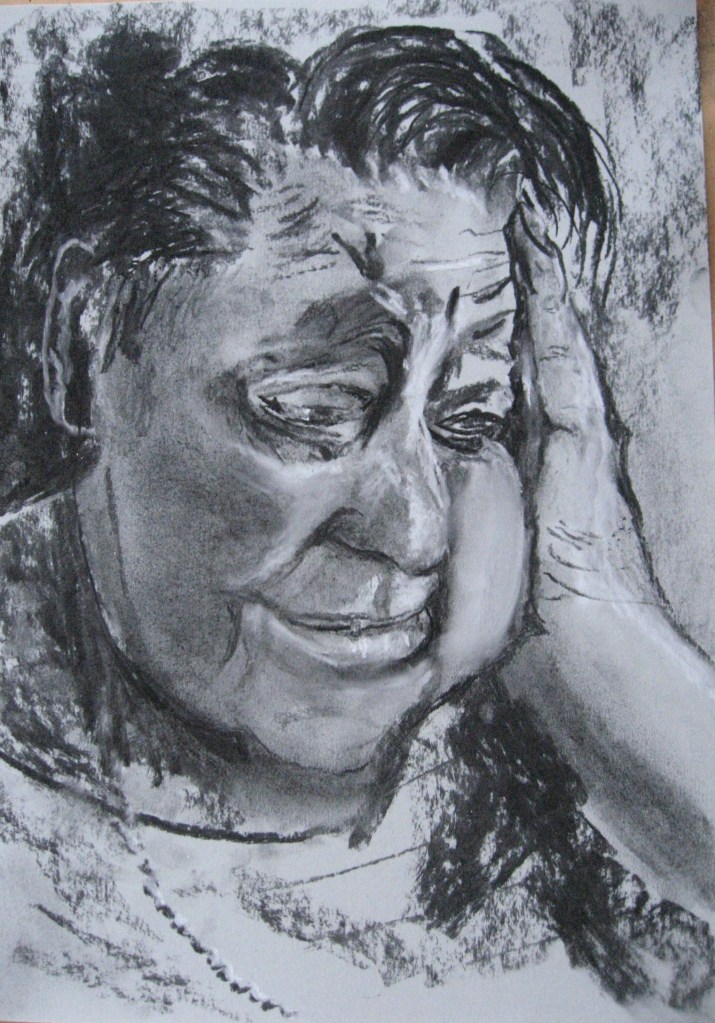
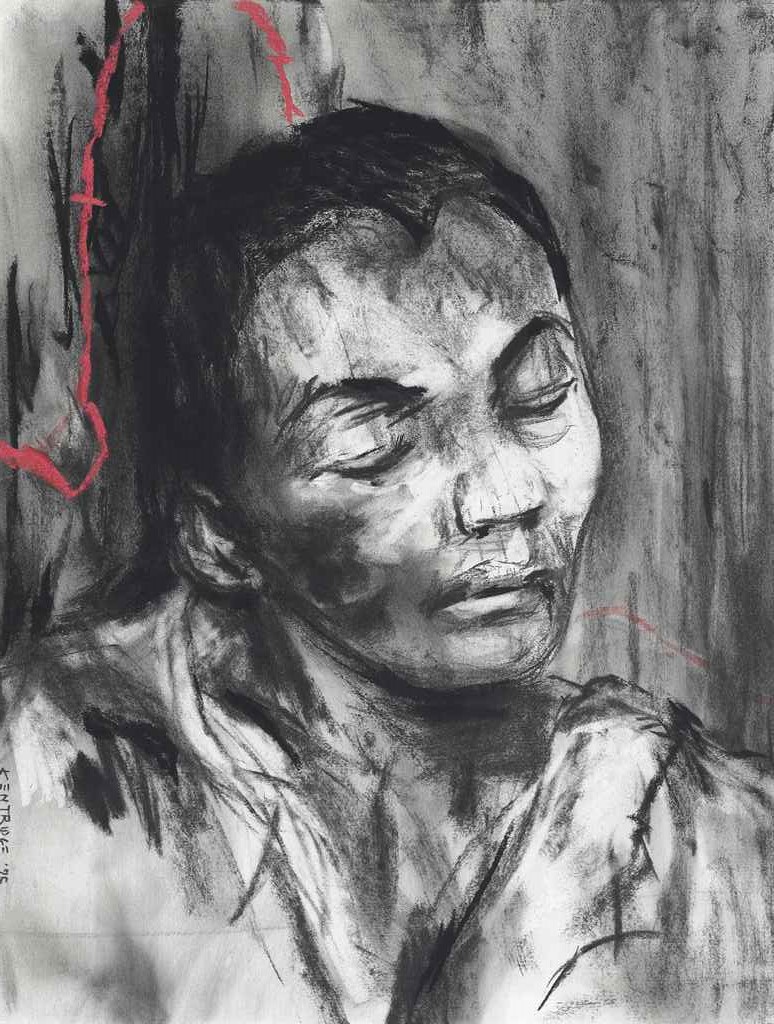
I include below examples of one of my portraits and one by Kentridge. Both demonstrate the lighter planes on the right of the face. These include light on the nose, lips and forehead.
My portrait Barbara Image 4
Kentridge’s portrait of Nandi Image 3
I have been improving my work through more drawing and through online life drawing. I have been using charcoal as my recently favoured medium and am utilising more broken lines in my drawing of figures. This helps give a more fluid natural feel and enhances movement in the figures. In order to do this, I use a range of different charcoal sticks. I use fine willow sticks, a range of different charcoal pencils, plus softer thicker charcoal sticks. Working in charcoal means that all my tones are in one colour and softer or darker shades of this black or dark grey substance. I have also learned that the use of smudging and erasing is crucial to the work as I find I am also drawing through erasing.
I use a soft putty eraser, a dust free eraser and a mechanical battery- operated eraser. Each one provides me with a diverse and richer drawing vocabulary, sometimes creating shadows, others creating deeper trace marks and sometimes the erasure into the charcoal is the form.
At this juncture it is important to focus on Appendix 1 Section A, to consider the work of Kentridge and my comparisons
Kentridge, his voice, and his impact on my work
In Appendix 1 Section A I considered the practical aspects of making work through the comparisons provided but in this next section it is vitally important to hear what Kentridge says about his work, what it means to him, and how this has impacted my work.
On the Royal Academy website there are a couple of videos where Kentridge talks about his work.
William Kentridge | Exhibition | Royal Academy of Arts
Accessed 30/10/22
‘My life as an artist and that’s when I could think of myself as an artist, was when I discovered working in charcoal. I’d done work in pencil graphite, oil paint but when I came to work on a larger scale the softness of charcoal was an opening up of possibility. The fact that one could alter a charcoal drawing just as quickly as you could think just with the wipe of the cloth. It was a medium that one could think rather than just make an image. So even if in the end the works are in inks or in cloth or are of a gesture of an actor their origin or strategy is that of working in charcoal.’ (Royal Academy video 2.08)
These words really resonate with me, particularly the first sentence. This medium is about how I feel the same when using it. Similarly, to Kentridge this medium is helping me to feel more like an artist with the work I am producing. I feel as confident with both the application of the charcoal and its erasure. It is so malleable without too much thought, I respond to the material, exploring its potential tonally, spontaneously and intuitively. I get lost in the moment of creating and transferring thought to the paper. This concept around Kentridge’s thoughts, are similarly integral to my work and processes as Stephen Clingman suggests.
‘For Kentridge drawing is as a kind of thinking, thinking a kind of drawing; drawing is a testing of ideas. A slow- motion version of thought. The uncertain and imprecise way of constructing a drawing is sometimes a model of how to construct meaning’
Transferring my thoughts through to my body, hands and through the tools to deliver and express my images onto the canvas or paper is such a strategically important process.
At this juncture I want to focus more on motivation, particularly in relation to creating work that could be contentious or difficult to witness on an emotional level. It is not hard to understand why Kentridge unravels difficult materials about South Africa and the apartheid regime. His parents, both lawyers who fought for justice and equality. They supported Black South Africans on trial. Those values are surely inevitably at the core of his existence.
In the future I plan to work on a project about child deaths. My previous career in Social Care often involved championing abused children. Similarly, to Kentridge the passion I hold for fairness, justice and to try to make a difference does not go away. It is part of who I am. I have been a witness to the aftermath of some horrendous crimes. I find I am drawn to use my art in a manner that raises awareness of some important issues. While I have not yet begun to visualise these images and transfer them to paper or canvas, I recognise that once I begin it will be difficult and for some people the images may not be easy to view.
Kentridge has again helped me reflect on these issues and to give them serious thought. In his animation titled Pain and Sympathy Art 21 ‘Extended Play’ he describes the feelings invoked for him around drawing difficult material.
https://www.bing.com/videos/search?q=William+Kentridge+
Accessed 3/1/23
‘In the activity of making there’s a sense that if you spend a day or two days drawing an object or image there’s a sympathy towards that object embodied in the human labour of making the drawing, and for me there is something in the dedication to the image whether its Jericho painting guillotined heads, it’s a shocking image but there’s something about the physical hours of studying and painting them that becomes a compassionate act for me even though on the one hand you could say it’s very cold bloodedly and ghoulishly looking at disaster or using other people’s pain as raw material for the work.’
(Extract from Pain and Sympathy 0.28 to 1.20)
Kentridge continues after we witness some graphic scenes of physical abuse. (Extract from Pain and Sympathy 1.50 to 2.15)
‘I mean naturally every artist does this ..use other people’s pain as well as their own as raw material so there is a kind of if not a vampirishness, certainly an appropriation of other people’s distress in the activity of being a writer or an artist. But there’s also something in the activity of both contemplating, depicting and spending time with it, which I hope as an artist, redeems the activity from one of simply exploitation and abuse.’
Knowing a little more about Kentridge, his background and his life helps me realise what a sensitive man he must be and he uses key words in his statement which is compassion and sympathy. What I find refreshing is Kentridge’s openness and his honesty about the redemption from the exploitation and abuse. These are very emotive and strong words about the use of other people’s real-life experiences. While I’m conscious that these are Kentridge’s words the ‘activity of contemplating, depicting and spending time with other people’s distress’ seems to suggest that there is a serenity, reverence and respect present within his thoughts and actions.
Witnessing difficult images invokes in us lots of different feelings and emotions. For example, having been to Kentridge’s exhibition it invoked in me, feelings of anger, shame, disgust, compassion, helplessness.
It is at this juncture that I introduce the work of Tina M Campt. She is a black German writer and is Roger S. Berlind ‘52 Professor of Humanities. Her work is also about visualising difficult subject matter. See Appendix 2 Section B
Conclusion
There is clearly a correlation between Kentridge and Campt in regard to the visceral engagement and response to difficult evocative material. However, Kentridge uses his drawings and animations. In contrast, Campt is commenting on Jaffa’s film clips of real-life events. In this regard it could be questionable which has the most impact although both clearly do.
Motivation in our choice of work as artists and what drives us is important. Kentridge has been inspirational and like many activists he is quite courageous.
If, however, there can be positive outcomes in raising issues as Kentridge’s work has done and Jaffa’s, then surely proceeding and creating work that makes us think and feel differently about the difficulties we see justifies the creation of such work, however difficult to create regarding our own personal emotional cost. If we are so moved by the work in our sensitization, it may also be the point at which we ‘take action,’ whatever that may be, as Campt suggests.
In considering my future project the main issues are about who I am representing and would the work be of benefit to children or their families? The work would be a form of reportage and education but may also have the potential to be a catalyst for change or improvement to services. I hold similar values to Kentridge about compassion and I now understand better my motivation. It’s about education, raising awareness with a view to affecting change.
On the more practical level, as I embrace the use of charcoal more, I embrace the spontaneity of it and how responsive it is to use. I’m less fearful of drawing. What is clear is the impact that studying Kentridge has had on my work not only in terms of the practical skills I’ve learned, but I’m now more confident in executing my work. What Kentridge says about drawing has given me permission to make mistakes but still confidently move forward. What he says about the ease of using charcoal and more importantly the multiple ways it can be used, is now embodied in my practice. From thick or thin lines, blurred lines, dense swathes of landscape, sculpting out the fine dust with erasure techniques and smudging. It’s become a magical journey and I can’t do enough drawing.
What I have learned from him and from feedback from my tutor on my work, is that the drawing process is all about the interlocking connections. As Kentridge says Drawing is like thinking. As I pick up the tools, the charcoal stick, it is my thoughts, concerns, intentions, a range of emotions from empathy to anger, and the passion within me begins to emerge onto my page. I connect with and feel a deep respect and anticipation of what my charcoal will help deliver. I trust in it and am more confident about what it delivers with every mark or erasure. It is about my mind, body and soul. I include the body, as a sweeping arm and bodily gestures also transfer to the hand and, are ultimately my tools. In this regard drawing is a full embodied experience.
Through research on Kentridge, I now know and understand my compulsion to report on difficult subject matter and more importantly, how any work of this nature needs to be treated with sensitivity, discretion, diplomacy, and respect.
I feel it is important that all that I have learned must not be lost. I shall continue to use charcoal and this new-found drawing experience that is embodied in self-discovery and improved skills.
Researching Campt has also been very relevant but it is important to note that I was viewing her work through white eyes. She stressed however that her book was for everyone, black and white people. While I can never appreciate what it must be like to live in black skin, I do believe that the issues of oppression and racism rest with white people who need to change to make for a better, fairer world.
Images
Fig 1
My own drawing size A5 Charcoal on paper Allotment scene
Fig 2
Image from the William Kentridge RA Catalogue.
Fig 3
Nandi from Felix in Exile.
Fig 4
My drawing Barbara
Fig 5
Image taken at the Royal Academy Exhibition of Kentridge’s work
Fig 6
My drawing of a seascape.
References
Websites
William Kentridge | Exhibition | Royal Academy of Arts
https://www.royalacademy.org.uk/exhibition/william-kentridge#video Accessed 20/12/23
https://www.bing.com/videos/search?q=William+Kentridge+
Review: A Black Gaze: Artists Changing How We See by Tina Campt – ARTnews.com!
Review: A Black Gaze: Artists Changing How We See by Tina Campt – ARTnews.com! Article by Zoe Samudzi Seeing Blackly 18/8/21
https://www.artnews.com/art-in-america/aia-reviews/tina-campt-black-gaze Accessed 3/2/23
Tina M. Campt — A Black Gaze – in conversation with Kimberly Drew – YouTube
https://www.youtube.com/watch?v=juqudevjg30
Accessed 3/2/23
Books
Clingman. S, William Kentridge, Royal Academy of Arts Exhibition Catalogue, 2022.
Bibliography
Websites
‘Felix in Exile‘, William Kentridge, 1994 | Tate
https://www.tate.org.uk/art/artworks/kentridge-felix-in-exile-t07479
Accessed 21/11/23
William Kentridge | Exhibition | Royal Academy of Arts
https://www.royalacademy.org.uk/exhibition/william-kentridge#video
Accessed 21/11/23
https://www.bing.com/videos/search?q=William+Kentridge+
Accessed 22/11/23
https://www.youtube.com/watch?v=zSkAblesq_c Accessed 7/2/23
 Drawing 2 Interpreting the environment